
 Jul 23, 2026

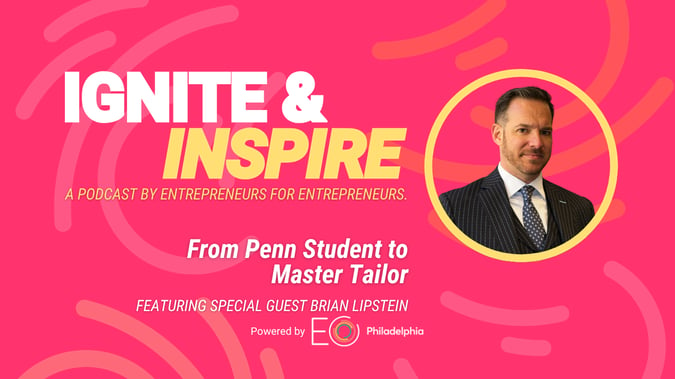
In a recent episode of the EO Philadelphia Ignite & Inspire Podcast, Tina Hamilton sat down with Brian Lipstein, the owner of Henry A. Davidsen Master Tailors and Image Consultants.
While Henry A. Davidsen specializes in custom clothing, the conversation wasn't really about suits. It was about leadership and the decisions business owners make long before the results become visible.
Opportunity Doesn't Wait for Perfect Timing
Brian started his business while he was still an undergraduate student at the University of Pennsylvania. Rather than waiting until graduation, he took advantage of a business incubator available through the university and began building a company while he still had access to those resources.
It would have been easy to wait, finish school, find a job, build experience, and then start a business someday. Instead, he recognized an opportunity and decided that imperfect action was better than waiting for perfect timing.
Many business leaders face similar moments. They often assume they need more time, more certainty, or more resources before they invest in improving their organizations.
Sometimes the best decision is simply to begin.
Building the Foundation While No One is Looking
Like many businesses, Brian’s company was hit hard during the pandemic. Revenue dropped dramatically, and for several months, they couldn't operate normally.
Many leaders would have focused solely on surviving, but Brian used that unexpected time differently.
His team called customers. Not to sell them anything, but simply to check in and ask how they were doing. At the same time, they filled gaps in their CRM, organized customer information, clarified their mission, refined their core values, and strengthened the foundation of the business.
That’s the foundational work that no customer sees.
No one congratulates you for documenting processes or cleaning up your systems. But those investments make everything else stronger.
Preparing Before You Need To
After COVID, Brian had another important decision to make.
His business was in its strongest cash position in years. Instead of simply holding onto that financial cushion and continuing to operate as usual, he invested in the Entrepreneurial Operating System (EOS), knowing it would require time, money, and commitment before he saw any return.
That decision wasn't about solving today's problems. It was about preparing for tomorrow's opportunities. Leadership often requires making investments before there's an obvious payoff.
The same is true for your people. Strong hiring practices, clear expectations, thoughtful onboarding, leadership development, and documented HR processes often feel easy to postpone because nothing appears broken. But they're exactly the kinds of investments that help organizations navigate growth, change, and unexpected challenges with greater confidence.
Whether it's hiring ahead of growth, developing future leaders, improving HR processes, implementing better technology, or creating clearer accountability, those decisions rarely produce immediate results.
But over time, they change what's possible.
Growth is Only One Goal
Brian made a distinction between growing a business and scaling one.
Growth often means adding more revenue alongside more expenses.
Scaling is different. It requires building systems, leverage, and infrastructure so the business can accomplish significantly more without increasing complexity at the same rate.
Whether your goal is to scale dramatically or simply build a healthier organization, the principle is the same. You can't build tomorrow's business using yesterday's systems.
At some point, every growing organization reaches a stage where investing in the foundation becomes more valuable than simply working harder.
Making Time Instead of Finding It
Brian shared how he thinks of slowing time down. Not literally, of course.
His point was that when leaders focus on their highest-value work and delegate everything else appropriately, they accomplish far more in the same amount of time. The result is that a week feels fuller. Not because more hours were added, but because those hours were used intentionally.
Many leaders are searching for more time.
Maybe the better question is whether we're investing enough in the people, processes, and systems that allow us to use our time differently.
Watch the Full Conversation
The businesses that seem prepared for growth rarely got there by accident. At some point, their leaders chose to work on the business instead of only in it.
They invested before they felt completely ready. They strengthened the foundation before it became urgent. And they understood that some of the most valuable work a leader does isn't the work that demands attention today.
It's the work that actually shapes what the business will become tomorrow.
The full conversation offers a thoughtful, real-world look at leadership, growth, and the people decisions that shape lasting organizations.
Watch on YouTube,
Topics discussed
ABOUT THE AUTHOR

Related Posts